Law Firm AEO

How AI Decides Which Law Firms Get Recommended

Search engines ranked law firms.
Answer engines do something very different.
When potential clients ask AI systems legal questions, those systems don’t browse the internet or compare dozens of websites. They generate an answer, and in doing so, they rely on a small number of sources they already recognize as trustworthy.
Law Firm AEO — AI Engine Optimization — is the process of making sure your firm is one of those sources.
If your firm is not part of those answers, you may still exist online — but you are absent at the exact moment a decision is being formed.

Built by the team behind LawShift.ai, LawFirmAEO.com focuses exclusively on how AI visibility works for law firms — and why traditional approaches to search are no longer enough.

Category Definition

What Law Firm AEO Actually Is

Law Firm AEO is not about ranking higher in search results or driving more traffic to your website. It’s about structuring authority in a way that AI systems can recognize, trust, and recall when they are asked questions about legal problems.
Answer engines like ChatGPT, Google’s AI Overviews, and Perplexity are trained to synthesize information, not retrieve pages. They look for patterns across the web that suggest expertise, consistency, and real-world relevance. Over time, they begin to favor certain firms as reliable sources of explanation.
ChatGPT
Google AI Overviews
Perplexity

AEO influences which firms AI systems remember and reference.

Once those patterns are established, they tend to reinforce themselves.
The Core Problem

Why Most Law Firms Never Appear in AI Answers

When someone asks AI a question like...
"Who is the best personal injury lawyer near me?"
"What should I do after a car accident?"
"Do I need a criminal defense attorney?"
...the system does not return a list of firms to choose from.

It generates a single response — sometimes mentioning one firm by name.

Those mentions don’t happen by accident. They come from firms that have demonstrated clear authority within a specific area of law, explained legal issues consistently over time, and sent strong trust signals that extend beyond their own website.
Most law firms, even well-established ones, were never structured to be understood this way. As a result, they remain invisible in AI-generated answers without realizing it.
The firms that appear are not necessarily better lawyers.
They've simply been structured in ways AI can interpret.
The Quiet Shift Already Happening

This Change Is Not Theoretical

This change is not theoretical or “coming soon.” It is already reshaping how legal visibility works.
A small number of firms are beginning to appear repeatedly in AI answers, while others — often in the same markets — are not mentioned at all. This has little to do with advertising budgets or how long a firm has been in business.

It has everything to do with how AI systems have learned to interpret authority.

As these systems continue to learn, they become more confident in the sources they rely on. The names they trust early tend to be reinforced through repeated use.
Firms that are not part of that learning early often find it difficult to break in later.

That's how visibility disappears — quietly, and without warning.

Practice-Area Specificity

Why AEO Is Practice-Area Specific

AI does not evaluate all law firms the same way. A personal injury firm, a family law practice, and a criminal defense firm are judged through completely different lenses.
Each practice area has its own client questions, language patterns, and signals of credibility. What establishes authority in one area of law may be irrelevant in another. That’s why generic “AI optimization” approaches rarely work for law firms.
Effective AEO starts by understanding how AI interprets authority within a specific practice area — and then structuring visibility around those expectations.

LawFirmAEO.com breaks this down by practice, beginning with the areas where AI visibility is already becoming competitive.

Personal Injury
Family Law
Criminal Defense
Immigration
Employment Law
Estate Planning
How It Works

How AI Chooses Which Firms to Trust

Answer engines are designed to reduce uncertainty. When generating responses to legal questions, they look for repeated confirmation across multiple sources, clear explanations of legal concepts, and signals that a firm is recognized beyond its own marketing materials.
They do not care how many keywords appear on a page or how much traffic a site receives. Instead, they learn from patterns — patterns of expertise, consistency, and external validation.
What AI looks for:

Repeated confirmation of expertise across the web. Clear, consistent legal explanations. Topical depth within a defined area of law. Signals that a firm is recognized beyond its own website.

What AI ignores:

Keyword density. Backlink volume for its own sake. Raw website traffic numbers. Traditional SEO tactics designed for ranking, not recognition.

AI systems synthesize patterns — and then repeat those patterns when generating answers.

AEO works by shaping what those systems learn.
Understanding the Difference

Why Law Firm AEO Is Not SEO

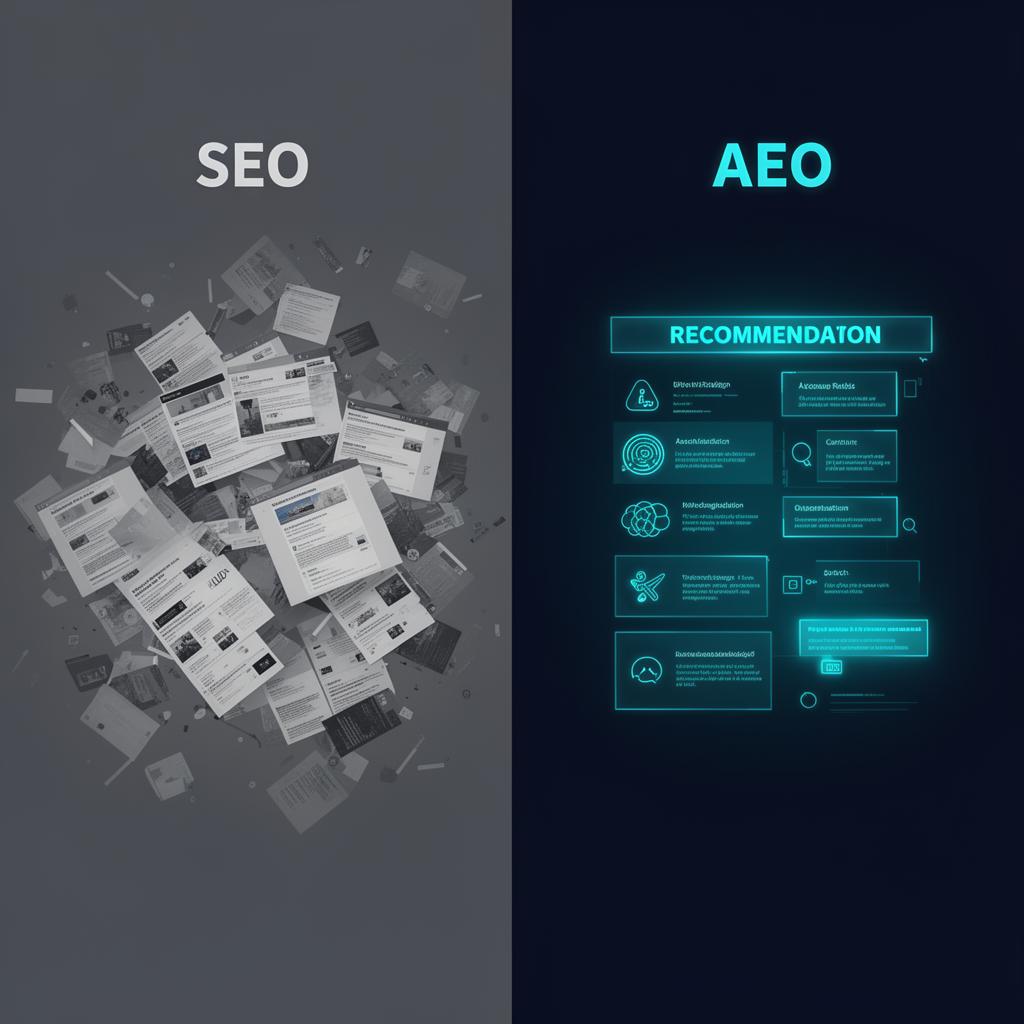
Traditional SEO focuses on ranking pages and capturing clicks. It is competitive, transactional, and often short-lived. Every algorithm update can reset progress. Every competitor can outbid you for attention.
AEO is about recognition and recall. Once a firm becomes a trusted reference for AI systems, visibility compounds rather than resets with each update. The systems learn to rely on certain sources — and that reliance deepens over time.
SEO tries to:

Rank pages higher than competitors. Win clicks through compelling titles. Capture traffic through search visibility. Compete for finite attention on results pages.

AEO focuses on:

Being recognized as an authority. Building trust through consistent explanation. Becoming the source AI recalls by default. Earning recommendation rather than competing for it.

SEO competes for attention.

AEO earns recommendation.

The two can coexist, but they solve very different problems — and require very different strategies.
The broader transformation of legal search — and why it is happening now — is explained in depth at LawShift.ai.
LawFirmAEO.com exists to take that shift one level deeper — to show how it plays out inside specific legal practice areas. It is less about the warning and more about the mechanics.

Same reality. Different focus.

Take Action

Understanding Your Firm's AI Visibility

Most law firms assume that because they have a website, AI systems can find them. Few understand whether those systems would actually recommend them.
If you want to understand how AI evaluates firms in your practice area, why some names surface repeatedly, and what signals influence those outcomes — AEO is the place to start.

Start with what matters most:

How AI evaluates firms in your practice area. What authority signals matter most. Why some firms are showing up — and others aren't.
AI systems are learning now.

Authority forms early — and is reinforced over time.